With my These Islands hat on, I've recently been looking at devolution from a Welsh perspective. In doing so I discovered that Wales offers a perfect case-study of why devolving spending powers is not necessarily a good thing for the devolved nation concerned. Those arguing for further devolution of spending powers to Scotland would do well to take note.
If the United Kingdom stands for anything, it stands for the pooling and sharing of resources. Without such pooling and sharing, Scotland, Wales and Northern Ireland wouldn't each be currently receiving many billions annually in fiscal transfers from England. Without those fiscal transfers, public spending in the devolved nations would need to be dramatically reduced (or, less realistically, tax revenues would somehow need to be dramatically increased).
Using ONS data2 we can see how significant these fiscal transfers currently are on a per person basis, not just nationally but also across England's regions.

To head off the standard Scottish Nationalist response: no this data doesn't show that Scotland is somehow being damaged by being in the UK. In fact it reflects the fact that Scotland is able to spend more on public services than it would be able to if it wasn't part of the UK. It's worth noting that transfers "in" for Scotland are caused almost entirely by relatively high spending, for Wales mainly by relatively low revenue and for NI by a mix of both relatively low revenue and high spend. I'll publish more complete analysis by nation/region soon.
The current mechanism for adjusting the budget available for devolved nations is the Barnett Formula. There are detailed briefings on the These Islands Website which explain both the history and mechanics of the Barnett Formula (How does the Barnett Formula actually work? and What is the Barnett Squeeze?), but all you really need to know is this: the Barnett Formula is not needs based, so changes in devolved budgets do not reflect changes in need.
The Barnett Formula in practice is highly sensitive to rates of change in population, resulting in it serving Scotland (with its declining population) relatively well compared to Wales and Northern Ireland. This is not in any way "fair" or "needs based". The chart below shows the impact over time of applying the Barnett Formula for Scotland, Wales and Northern Ireland, using realistic assumptions and where the only difference between the three nations' formula driven per capita budgets is their actual relative rates of population growth/decline.

This in-built unfairness is why whenever anybody sensible takes a look at the Barnett Formula, the conclusion is the same: it needs to be replaced by a needs based formula.

That the Barnett Formula remains in place today is testament to the combined forces of political inertia and the strength of the Scottish parliament. Scotland is most likely to suffer (relatively) if a "fairer" mechanism for allocating spending among the devolved nations is put in place.
This is of course why, when "The Vow" was being delivered, the SNP insisted that the Smith Commission recommendations included the line "the block grant from the UK government to Scotland will continue to be determined by the Barnett Formula". It's also why the SNP dropped their brief flirtation with the idea of "Full Fiscal Autonomy" for Scotland, because that would mean scrapping the fiscal transfers that enable Scotland's higher public spending.
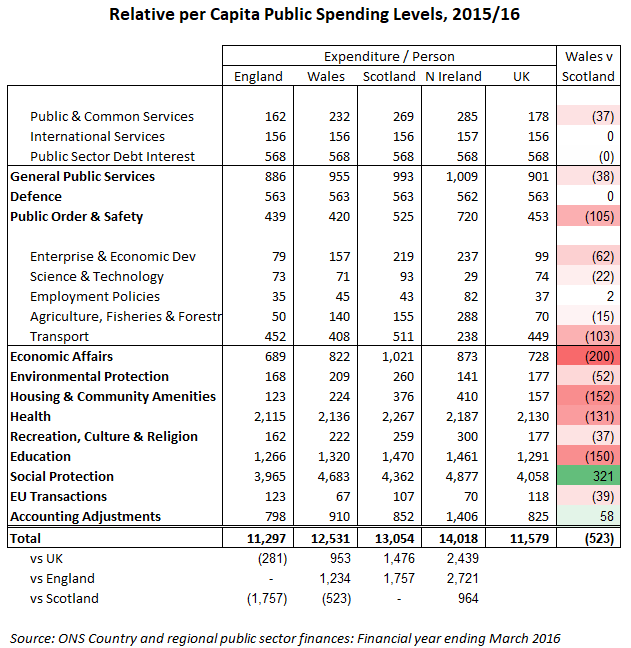
What struck me when looking at the relative per capita spending data for Wales (see table below) was that the only comparable area of spending where Wales receives a higher per capita spend than Scotland is Social Protection. Social protection is of course not devolved, it's fully reserved. Being fully reserved it is effectively guaranteed to be allocated on a needs basis, because the entitlement to (for example) a State Pension is standard UK3 wide - if there are proportionately more pensioners4 in Wales, they'll get proportionately more funding.
Now look at all those other areas where Wales has less per capita spending than Scotland
- Health and Education are fully devolved - so we know that Wales' capacity to spend in these areas has suffered relative to Scotland due to the way the Barnett Formula works
- Transport is c.80% devolved, so tells a similar story
- The mix of devolved vs reserved is less clear for other areas - but we can observe significantly lower spend for Wales relative to Scotland in "Economic Affairs", "Housing & Community Amenities", "Enterprise & Economic Development", ...
At this point the analysis only really takes me far enough to ask a pointed question: are these lower spend levels for Wales justified by lower need, or has the Barnett Formula left Wales unfairly starved of funds?
This is a blog, so you'll perhaps forgive a rambling conclusion (Chokkablog's motto is "thinking allowed" after all):
- From a "UK-wide" perspective, devolving further spending powers without replacing the Barnett Formula with a needs based formula would be both imprudent and reckless - because the Barnett Formula is not "fair"
- Devolving revenue raising powers carries similar risks. Even if you allow some base level fiscal transfer to remain (i.e. so that if 100% of revenue raising powers were devolved, Scotland would still receive some of England's tax revenues) you would still be exposed to the problem of how that figure was adjusted over time. It's also hard to see how such a situation would be tenable from an English perspective - the more revenue powers are devolved, the closer we edge to Full Fiscal Autonomy. Regular readers of this blog know that would be a terrible idea for Scotland
- Devolving Social Protection powers (for Scotland or Wales) would take away the assurance of "needs based" funding that reservation of those powers gives
- There's a democratic trade-off involved in accepting that the UK-wide priorities may not be the same as those Scotland or Wales alone would choose - but being in a union is all about compromising how much influence you have in return for enjoying the benefits that accrue from being part of a greater whole. The data suggests Scotland does pretty well out of "the greater whole". At least as far as the Barnett formula is concerned, that's more by accident than design.
NOTES
1. Profile: Donald Dewar the architect of the Scottish Parliament
2. Country and regional public sector finances: Financial year ending March 2016
These figures are used to allow consistent comparisons between regions and nations. The "geographic" (favourable to Scotland) N Sea revenue allocation methodology figures are used, but in the year in question N Sea revenues were only c.£60m or about £11/capita for Scotland (so frnaly irrlevant).
The deficit for Scotland using these figures is slightly higher than that shown by the 2016/17 Scottish Government GERS Report (£15.2bn vs £14.5bn in GERS for 2015/16 - a £130/capita difference).
The figures are very close also to the GERW data produced by Cardiff University for Wales (£14.8bn vs £14.7bn).
3. Except NI
4. As indeed there are: ONS data

